




.png)

.png)


Is a Self-Service Kiosk Worth the Cost?
Self-service kiosks are widely adopted across restaurants, retail stores, hotels, and supermarkets. As labor costs rise and customers expect faster service, businesses are increasingly turning to kiosk-based ordering and payment solutions.
However, self-service kiosk pricing varies significantly depending on hardware, software, and customization requirements. This guide explains what affects the cost and how to budget for the right solution.
Request a customized self-service kiosk quote →
How Much Does a Self-Service Kiosk Cost on Average?
Self-Service Kiosk Pricing Overview
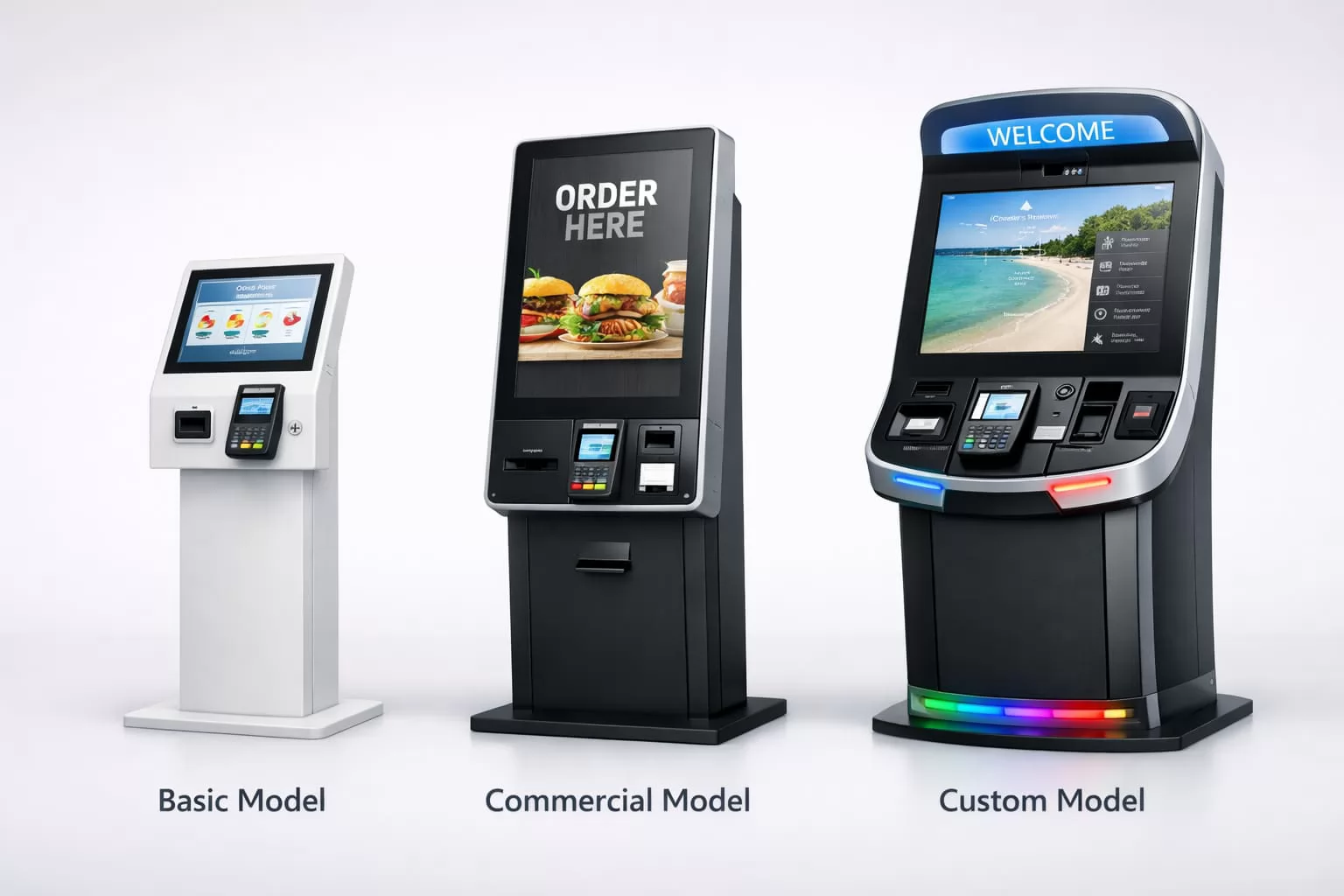
The cost of a self-service kiosk varies depending on hardware configuration, software features, and customization level. The table below shows typical pricing ranges for commercial deployments.
| Kiosk Type | Typical Use Case | Hardware & Software Scope | Price Range (USD) |
|---|---|---|---|
| Entry-Level Self-Service Kiosk | Basic ordering, check-in, information display | Standard touchscreen, basic POS software, limited payment options | Lower initial investment |
| Mid-Range Commercial Kiosk | Restaurants, retail stores, chain businesses | High-performance touchscreen, full POS integration, card & QR payments | Moderate investment range |
| High-End / Custom Kiosk | High-traffic venues, branded customer experience | Custom enclosure, advanced software, ERP & system integrations | Higher investment based on requirements |
Actual self-service kiosk pricing depends on your business requirements, location, and deployment scale. Customized quotations provide the most accurate cost estimate.
The average cost of a commercial self-service kiosk depends on its configuration and intended use. Most business deployments fall into one of the following categories:
- Entry-level self-service kiosks for basic ordering or check-in
- Mid-range kiosks for restaurants, retail, and chain stores
- High-end or custom kiosks for complex workflows and branded experiences
Instead of fixed pricing, professional suppliers usually provide customized quotations based on business needs and deployment scale.
Key Factors That Affect Self-Service Kiosk Pricing
Hardware Configuration
Hardware components play a major role in determining kiosk cost. This includes touchscreen size and durability, internal computing performance, and peripherals such as printers, barcode scanners, cameras, and speakers.
Payment hardware supporting card, NFC, QR code, or cash modules can also significantly impact pricing.
Software and System Integration
A self-service kiosk is powered by software. Costs may include POS system licensing, kiosk management software, custom UI and UX design, and integration with inventory, ERP, or payment gateways.
Customization and Branding
Businesses often require customized kiosk enclosures, branded user interfaces, multilingual support, and compliance with local regulations. These customizations increase upfront costs but deliver higher long-term value.
Self-Service Kiosk Cost by Industry
Restaurants and Quick Service Restaurants (QSR)
Ordering kiosks help restaurants reduce queue times, improve order accuracy, and increase average order value through upselling.
Retail and Self-Checkout
Retail self-service kiosks are used for self-checkout, price verification, loyalty programs, and product discovery.
Hotels and Hospitality
Hotel kiosks support self check-in, check-out, and guest services while reducing front-desk workload.
Supermarkets and Chain Stores
Large-scale deployments require centralized management, analytics, and scalable kiosk infrastructure.
One-Time Investment vs Ongoing Costs
When evaluating self-service kiosk cost, businesses should consider total cost of ownership rather than upfront price alone.
- Initial hardware purchase and installation
- Software subscription and licensing fees
- Maintenance, updates, and technical support
- Future system upgrades and expansion
Buy, Lease, or Customize: Choosing the Right Cost Model
Some businesses choose standard kiosk models for quick deployment, while others benefit from fully customized self-service kiosk solutions designed around their workflows and branding.
For growing brands and multi-location operators, customized kiosks often deliver better scalability and ROI.
ROI: How Fast Can a Self-Service Kiosk Pay for Itself?
Self-Service Kiosk ROI Breakdown
Beyond initial cost, many businesses evaluate self-service kiosks based on return on investment (ROI). The table below highlights common ROI drivers across industries.
| ROI Factor | Business Impact | Operational Benefit |
|---|---|---|
| Labor Cost Reduction | Fewer staff required during peak hours | Lower long-term operating expenses |
| Higher Order Accuracy | Reduced human error in ordering | Fewer refunds and customer complaints |
| Increased Average Order Value | Automated upselling and add-ons | Higher revenue per transaction |
| Faster Service Throughput | Shorter queues and wait times | Improved customer satisfaction |
| Scalability | Easy deployment across multiple locations | Consistent performance and management |
In high-traffic environments such as restaurants and retail stores, businesses often achieve ROI within a predictable operational period, depending on usage volume and configuration.
A well-implemented self-service kiosk solution can generate returns through:
- Reduced labor dependency
- Higher order accuracy
- Increased average transaction value
- Improved customer experience and throughput
In high-traffic environments, many businesses see a positive return on investment within a short operational period.
Why Choose Jassway for Your Self-Service Kiosk Solution
Jassway provides end-to-end self-service kiosk solutions, combining commercial-grade hardware with flexible POS software.
- Integrated hardware and software development
- Custom kiosk manufacturing and UI design
- Industry-specific solutions for retail and food service
- Professional deployment and after-sales support
How to Get an Accurate Self-Service Kiosk Quote
To provide accurate self-service kiosk pricing, our team evaluates your industry, hardware requirements, software integrations, and deployment scale.
Frequently Asked Questions About Self-Service Kiosk Pricing
How much does a basic self-service kiosk cost?
The cost depends on hardware configuration and software requirements. Entry-level kiosks are more affordable but offer fewer customization options.
Can small businesses afford self-service kiosks?
Yes. Many kiosk solutions are scalable and can be tailored to fit small and medium-sized businesses.
Are self-service kiosks expensive to maintain?
Ongoing costs are generally predictable and often lower than long-term labor expenses.
How long does a commercial self-service kiosk last?
Commercial-grade kiosks are designed for long-term use with proper maintenance and software updates.
Conclusion
The cost of a self-service kiosk depends on hardware, software, customization, and long-term operational needs. Choosing the right solution partner is critical to maximizing ROI.
.png)